lunes, 28 de abril de 2014

Holy week

One of the great things about Spanish life is the absurd number of public holiday .
Holy Week,  is like a Catholic version of Spring Break.
1. Processions
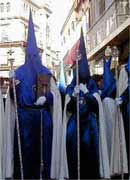
Religious processions are a big deal for a lot of people, and they basically involve taking the images of the Virgin Mary or of Christ out of the local church and walking them very slowly around the neighborhood. There are lots of guys in pointy hats–KKK-style, which is creepy.
Since it’s always raining somewhere in Spain during springtime, you can see the news reports of small-town people weeping because they can’t take their Virgin out–they spend a lot of time preparing for these things and it ruins their whole spring when the procession is cancelled. But at some point during the week you should be able to catch one. They’re a little bit boring if you’re going to stand there and watch the whole thing–don’t say I didn’t warn you!
2. Torrijas
Please, whatever you do, don’t tell a Spaniard that their torrijas are just what we call French Toast by another name. Well, almost. I guess we could fixate on the little differences (torrijas are fried rather than cooked on a griddle, for example) but I’d say that torrijas are a pretty good stand-in for French Toast anytime. Also big at this time of year are buñuelos


From my point of view, here in Ceuta the processions are quite good.
As I'm musician in a musical band of Ceuta. I have to play the trumpet for one procession every day following the different Virgins. I think that the only " bad " thing is that all the procesion pass the same places because Ceuta isn't very big and the majoraty of them starts in the city center.
But in my opinion I think it is very beautiful to watch the imagies in the smalls streets in Ceuta.


In Ceuta the Holy Week is fantastic because the people like it. That the procession go out with the militaries and legiones too.
In my opinion the procession that I like is " The Meeting " " El Encuentro " because it is when the Virgin meets with her son " Jesus ".
The penitents with tunics and a purple mask and sash. These walk with the float that has Jesus on it. The others penitents wear white tunics and a green powled hat and sash who go with the Virgin's float.
If it  is raining the floats don't go out and the bearers are very sad because they have practising for a long time.
This year  all the floats could go out because the weather was very good so everyone was happy. 


Here in Spain, in Ceuta, the Holy Week, the processions, etc. are very important for us, the worshipers (the cristians).
Holy Week is specially celebrated in the South of Spain, in Andalucia. Many people take part in the processions, not only adults, but children, too. For many years, Holy Week here in Spain has been very important and meaningful. That's why people who like it very much take part a lot and take care of the details about it.
For me, Holy Wek is my favourite holiday, I don't know exactly why. Maybe it is because since I was a child, my mother has tried to bring me up to like ''Holy Week''.
In my opinion, one of the most beautiful floats is ''The Meetting'' where two floats meet and greet each other.
It's very exciting for me to see the Holy Week processions, especially here because I think each Holy Week in Ceuta is different from the others one.
Finally I think that what brings people to like Holy Week, is because each procession and float has its own ''personality''.  


Last week was Holy week. I think that Holy week is boring because I don't belive in God but for the other people it is the one of best time of the year. When they watche they cry a lot because they become emotional. In my I don't like Holy week even though the "thrones" I think are very  beautiful with their wooden cared sigles covered where in silver or gold.
This year in the Holy week I didn't go the processions. I was in Malaga. My parents asked me to go to the center to watch the processions. But if you go you  need to walk a lot so I didn't go.
My sister told me that the most beautiful processions in Spain are in Malaga and in Sevilla.

In Spain Holy Week is an important time for christians. The brotherhoods bring some image from the cathedral or their churches to celebrate when Jesus went into Jerusalen and the people welcomed him with palms, when he death and resurrection. In my opinion the best days are Palm Sunday because is the first day of "the Holy Week", and Tuesday, because the bearers represent very well the meeting of Christ with the Virgin which is called the "Encuentro".

domingo, 27 de abril de 2014

Culture shock

What you need to know about Culture Shock

Most people who move to a foreign country or culture may experience a period of time when they feel very homesick and have a lot of stress and difficulty functioning in the new culture. This feeling is often called ‘culture shock’ and it is important to understand and learn how to cope with culture shock if you are to adapt successfully to your new home’s culture.
First of all, it’s important to know that culture shock is normal. Everyone in a new situation will go through some form of culture shock, and the extent to which they do is determined by factors such as the difference between cultures, the degree to which someone is anxious to adapt to a new culture and the familiarity that person has to the new culture. If you go, for example, to a culture that is far different from your own, you’re likely to experience culture shock more sharply than those who move to a new culture knowing the language and the behavioural norms of the new culture.
There are four general stages of cultural adjustment, and it is important that you are aware of these stages and can recognise which stage you are in and when so that you will understand why you feel the way you do and that any difficulties you are experiencing are temporary, a process you are going through rather than a constant situation.
The first stage is usually referred to as the excitement stage or the ‘honeymoon’ stage. Upon arriving in a new environment, you’ll be interested in the new culture, everything will seem exciting, everyone will seem friendly and helpful and you’ll be overwhelmed with impressions. During this stage you are merely soaking up the new landscape, taking in these impressions passively, and at this stage you have little meaningful experience of the culture.
But it isn’t long before the honeymoon stage dissolves into the second stage – sometimes called the withdrawal stage. The excitement you felt before changes to frustration as you find it difficult to cope with the problems that arise. It seems that everything is difficult, the language is hard to learn, people are unusual and unpredictable, friends are hard to make, and simple things like shopping and going to the bank are challenges. It is at this stage that you are likely to feel anxious and homesick, and you will probably find yourself complaining about the new culture or country. This is the stage which is referred to as ‘culture shock’.
Culture shock is only temporary, and at some point, if you are one of those who manage to stick it out, you’ll transition into the third stage of cultural adjustment, the ‘recovery’ stage. At this point, you’ll have a routine, and you’ll feel more confident functioning in the new culture. You’ll start to feel less isolated as you start to understand and accept the way things are done and the way people behave in your new environment. Customs and traditions are clearer and easier to understand. At this stage, you’ll deal with new challenges with humour rather than anxiety.
The last stage is the ‘home’ or ‘stability’ stage – this is the point when people start to feel at home in the new culture. At this stage, you’ll function well in the new culture, adopt certain features and behaviours from your new home, and prefer certain aspects of the new culture to your own culture.
There is, in a sense, a fifth stage to this process. If you decide to return home after a long period in a new culture, you may experience what is called ‘reverse culture shock’. This means that you may find aspects of your own culture ‘foreign’ because you are so used to the new culture that you have spent so long adjusting to. Reverse culture shock is usually pretty mild – you may notice things about your home culture that you had never noticed before, and some of the ways people do things may seem odd. Reverse culture shock rarely lasts for very long.

TRUE - if the statement agrees with the information
FALSE - if the statement contradicts the information
NOT GIVEN - if there is no information on this
  1. Some people will find the process of adapting to a new country easier than others.
  2. Knowing about these four stages will help people adjust to a new culture more quickly.
  3. People can ease culture shock by learning about the language and customs before they go to the new culture.
  4. Culture shock is another name for cultural adjustment.
  5. The first stage is usually the shortest.
  6. In the first stage, people will have a very positive impression of the new culture.
  7. Many people will leave the new culture while they are in the second stage.
  8. By the third stage, people do not experience any more problems with the new culture.
  9. In the fourth stage, people speak the new language fluently.
  10. Reverse culture shock is as difficult to deal with as culture shock.


Culture shock : a fish out of water

CULTURE SHOCK: A Fish Out Of Water

Introduction:
1. Kalvero Oberg was one of the first writers to identify five distinct stages of culture shock. He found that all human beings experience the same feelings when they travel to or live in a different country or culture. He found that culture shock is almost like a disease: it has a cause, symptoms, and a cure.
Body:
2. Whenever someone travels overseas they are like "a fish out of water." Like the fish, they have been swimming in their own culture all their lives. A fish doesn't know what water is. Likewise, we often do not think too much about the culture we are raised in. Our culture helps to shape our identity. Many of the cues of interpersonal communication (body language, words, facial expressions, tone of voice, idioms, slang) are different in different cultures. One of the reasons that we feel like a fish out of water when we enter a new culture, is that we do not know all of the cues that are used in the new culture.
3. Psychologists tell us that there are five distinct phases (or stages) of culture shock. It is important to understand that culture shock happens to all people who travel abroad, but some people have much stronger reactions than others.
4. During the first few days of a person's stay in a new country, everything usually goes fairly smoothly. The newcomer is excited about being in a new place where there are new sights and sounds, new smells and tastes. The newcomer may have some problems, but usually accepts them as just part of the newness. They may find themselves staying in hotels or be with a homestay family that is excited to meet the foreign stranger. The newcomer may find that "the red carpet" has been rolled out and they may be taken to restaurants, movies and tours of the sights. The new acquaintances may want to take the newcomer out to many places and "show them off." This first stage of culture shock is called the "honeymoon phase."
5. Unfortunately, this honeymoon phase often comes to an end fairly soon. The newcomer has to deal with transportation problems (buses that don't come on time), shopping problems (can't buy favorite foods) or communication problems (just what does "Chill out, dude." mean?). It may start to seem like people no longer care about your problems. They may help, but they don't seem to understand your concern over what they see as small problems. You might even start to think that the people in the host country don't like foreigners.
6.This may lead to the second stage of culture shock, known as the "rejection phase." The newcomer may begin to feel aggressive and start to complain about the host culture/country. However, it is important to recognize that these feelings are real and can become serious. This phase is a kind of crisis in the 'disease' of culture shock. It is called the "rejection" phase because it is at this point that the newcomer starts to reject the host country, complaining about and noticing only the bad things that bother them. At this stage the newcomer either gets stronger and stays, or gets weaker and goes home (physically, or only mentally).
7. If you don't survive stage two successfully, you may find yourself moving into stage three: the "regression phase." The word "regression" means moving backward, and in this phase of culture shock, you spend much of your time speaking your own language, watching videos from your home country, eating food from home. You may also notice that you are moving around campus or around town with a group of students who speak your own language. You may spend most of this time complaining about the host country/culture.
8. Also in the regression phase, you may only remember the good things about your home country. Your homeland may suddenly seem marvelously wonderful; all the difficulties that you had there are forgotten and you may find yourself wondering why you ever left (hint: you left to learn English!). You may now only remember your home country as a wonderful place in which nothing ever went wrong for you. Of course, this is not true, but an illusion created by your culture shock 'disease.'
9. If you survive the third stage successfully (or miss it completely) you will move into the fourth stage of culture shock called the "recovery phase" or the "at-ease-at-last phase." In this stage you become more comfortable with the language and you also feel more comfortable with the customs of the host country. You can now move around without a feeling of anxiety. You still have problems with some of the social cues and you may still not understand everything people say (especially idioms). However, you are now 90% adjusted to the new culture and you start to realize that no country is that much better than another - it is just different lifestyles and different ways to deal with the problems of life.
10. With this complete adjustment, you accept the food, drinks, habits and customs of the host country, and you may even find yourself preferring some things in the host country to things at home. You have now understood that there are different ways to live your life and that no way is really better than another, just different. Finally you have become comfortable in the new place.
11. It is important to remember that not everyone experiences all the phases of culture shock. It is also important to know that you can experience all of them at different times: you might experience the regression phase before the rejection phase, etc. You might even experience the regression phase on Monday, the at ease phase on Tuesday, the honeymoon phase on Wednesday, and the rejection phase again on Thursday. "What will Friday be like?"
12. Much later, you may find yourself returning to your homeland and - guess what? - you may find yourself entering the fifth phase of culture shock. This is called "reverse culture shock" or "return culture shock" and occurs when you return home. You have been away for a long time, becoming comfortable with the habits and customs of a new lifestyle and you may find that you are no longer completely comfortable in your home country. Many things may have changed while you were away and - surprise! surprise! - it may take a little while to become at ease with the cues and signs and symbols of your home culture.
Conclusion
13. Reverse culture shock can be very difficult. There is a risk of sickness or emotional problems in many of the phases of culture shock. Remember to be kind to yourself all the time that you are overseas, and when you get home, give yourself time to adjust. Be your own best friend. If you do these things you will be a much stronger person.If you do these things, congratulations, you will be a citizen of the world!
*** * ***
    a. What’s going to happen to a fish if it lives out of water?
      b. What is culture shock?


A Quiz 
http://international.ouc.bc.ca/cultureshock/qzdx.html


domingo, 20 de abril de 2014

Should - Must - Have to | English Modal Verbs


Read the following situations and fill in one of the following  verb forms:,
should, shouldn't, should have, shouldn't have , don't have to, doesn't have to,  must, mustn't, must have.
 

 It’s 8.15 and school starts at 8.00. Mother to son:
                                               
1 You  be at school at this time.
2 You  skip school, it’s bad for your education. It's also against the rules.
3 You  got up so late.
4 You  take a bus, I’ll drive you to school.
5 You  go to bed earlier at night. You'd feel more relaxed in the morning.

1. should                             2. mustn't        
 3. shouln't have                  4. don't have to 
 5. should 


Tom looks very pale and tired.       
                                                   
1 He  studied a lot today.
2 He  rest a little before supper. It would do him good.
3 He  study so hard, he knows his lessons very well.
4 He  gone out for a walk in the middle of the afternoon.
5 He   try to be less scared of tests. He wouldn't suffer so much. 
6 He  be very worried about tomorrow’s Maths test. 
  
1. must have                           2. should 
3. don't have to                       4. should have 
5.should                                  6. must 


Jerry said he would invite me to his party but he didn’t.
                                         
 
1 He  make false promises.
2 You’re such a fun at parties, he  invited you.
3 You  get offended, he may have forgotten to ring you up.
4 You  think there’s something wrong with you. It was Jerry’s mistake.
5 If  you don’t go to his party, you  buy him a present. That is an advantage!

1. shouldn't                                 2.  should have 
3. shouldn't                                 4.  mustn't 
5. don't have to 

 
 Look, there’s going to be a terrible storm soon.


1 We  hurry home. I think it would be better and safer.
2 We  brought an umbrella. We could have walked in the rain.
3 We  stand under a tree. It’s too dangerous.
4 Look, there’s a man selling umbrellas. We  absolutely buy one.
5 We  pay very much. I think 5 dollars will be enough.

1. should                         2. should have 
3. mustn't                        4. must 
5. don't have 


The house smells of smoke. It’s terrible.
         
 
1 Tom is in his room, he  be smoking and he never closes the door.
2 He  smoke so much. It’s bad for his health.
3 He  smoked at least 10 cigarettes since this morning.
4 You  told him that he could smoke in his bedroom.
5 He  try to give up this bad habit.

1. must                         2. shouldn't
3. must have                4. shouldn't have 
5 should 


miércoles, 2 de abril de 2014

Holy week in Spain

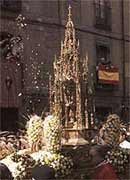
Spain celebrates Easter Week much more than most European countries. During the whole of Semana Santa, (Holy Week), street processions are organised in most Spanish towns each evening, from Palm Sunday to Easter Sunday.
People carry statues of saints around on floats or wooden platforms, and an atmosphere of mourning - which can seem quite oppressive to onlookers - and the Easter week processions end with Easter Sunday, a day full of light and colour when church and cathedral bells are heard ringing throughout the country.
HOLY WEEK IN SPAIN
HOLY WEEK IN SPAINIn some of the processions, marchers wear clothes reminiscent of the klu klux klan. Infact their clothes are meant to depict the Nazareños, people from Nazareth. The religious fraternities and brotherhoods are responsable for carrying the statues and organising the penitents and musicians. The Nazareños follow the people who carry the floats bearing sculptures and models of biblical scenes.
The people who carry the weight of the floats are called "costaleros" and are expected the carry these "thrones" with solemnity and grace. They use a small cushion, "costal" to protect themselves from getting sores from the wood rubbing against their skin during the long processions.
The most famous Easter celebrations are held in various Andalusian towns, Valladolid, Toledo, Segovia, Burgos, Zamora and Cuenca.

domingo, 30 de marzo de 2014

Computer :learning a language

JOHNSON’s first foreign-language class was typical: a gaggle of 14-year olds, hormones raging, are gathered in a classroom when Señora White strolls in. ¡Hola y bienvenidos a la clase de español! Puberty is a terrible time to begin a language. One’s own parents are embarrassing enough. But to repeat nonsense words with strange gurgling and burbling sounds while the cute new classmate watches from the next desk can be mortifying. For many learners, the experience leaves lifelong scars.
Language is social. But it is not always best learned socially. Today, the first encounter with a foreign language can skip the public-shaming entirely. Digital programs get those first few stuttered words out in the privacy of one’s one home. No over-cheerful teacher, no giggling classmates: whether one is 13 or 31, some things are best experienced alone before being tried with another. Language-learning may well be one.
Software programs like Rosetta Stone, Duolingo, Babbel and Mango offer what purport to be complete language courses. But it is a good idea to supplement them. Consider vocabulary-building. There is simply no way around the slog of building vocabulary piece-by-piece, slowly but steadily. The programs that promise to shortcut this are misleading. But digital tools make time spent on the task much more efficient. “Fluent Forever”, a new book by Gabriel Wyner, describes the power of spaced repetition. In short, repeat a learned fact shortly after you’ve first learned it, then repeat it after a slightly longer interval, then at a longer interval still. This kind of training—refreshing a memory just before it is likely to fade—is more effective than brute-force training a word over and over upon first learning, or learning once and then trying to cram it back into the skull weeks later.            
The insight into spaced repetition is not a new one, but clever digital tools make it newly available. Memrise (free) is one, with already-built courses in many languages available.Anki is another (free web version, with a $25 app for mobile and offline use). It lets users build flash cards, and remembers how recently they have been trained, calling older ones up at suitable intervals. Better yet, Anki makes it a snap to make flash cards with pictures rather than words. (Just copy an image and then paste it onto the card.) Mr Wyner rightly reckons that the act of finding a memorable image (Google Images being an easy way to do so) is a powerful one. If you put your perfect picture for the Spanish perro or guapo on the back of your flashcard, this creates a richer and more recallable memory than the boring translations dog and handsome. The mind is designed to remember meaningful things, not everything. What's more meaningful than a cute dog or an attractive person? Once upon a time, creating customised, richly memorable flashcards would take art skills and huge amounts of time. Anki makes it easy to make dozens in a half-hour study session. (Incidentally, if English is your foreign language, or you merely want to work on English vocabulary, the game-like new $3 app from Vocabulary.com is a fast and fun way for learning English words. The definitions are clever and memorable, and it also uses a form of spaced repetition.) 
For grammar, computers are similarly helpful, patient with helping the intermediate learner through the dozens, hundreds or thousands of repetitions needed to get comfortable with it. Grammar is simply a set of patterns: in environment X, a word from class Y is needed, and it might need modification Z. A teacher may snort when you haven’t nailed the masculine singular dative on the third go (after all, you’ve had three chances, and there are other students trying to learn here). But a computer will not so much as sigh. For this reason, for the grammar-shy but willing-to-try, programs like Rosetta Stone and Duolingo are ideal. They focus on reasonably sized chunks of grammar, and drill over and over again, with just slight changes each time. Rosetta Stone has the advantage of using rich pictures and high-quality sound. Duolingo, however, is free, offers actual explanations alongside drills, and uses the same spaced-repetition idea for grammar as Anki does for vocabulary. (It prompts you to “practise weak skills”, and this is often more rewarding than pushing on for the sake of feeling like you are making progress.)
Computers do not replace all traditional learning tools. A good grammar book remains essential—software often tries to skimp on the explanations, for the sake of trying to make language-learning easier than it is. And of course once you are comfortable, there is no replacement for practice with native speakers. But even there, computers are a big help: Benny Lewis, another polyglot touting a new book (“Fluent in Three Months”, cheerful but less scientific than Mr Wyner’s), gushes about finding cheap teachers and volunteer practice partners on Skype and other video-chat platforms.
In other words, practice with a native-speaker is essential. But there are a lot of boring bits of language-learning best done alone. They reward repetition—a few minutes a day is far better than one cramming session a week. Assisting this kind of practice is one thing computers are much better at than humans. Who knew machines could be so good at helping people with the most quintessentially human skill?